Application Form
Questions 1–7
Complete the form below.
Write NO MORE THAN THREE WORDS AND/OR A NUMBER for each answer.
Application Form
- Example Type of card requested: credit
- Name:
- Address:
- Town:
- Home phone no.: 95378082
- Date of birth:
- Name of employer: Summer Breezes Ltd
- Work phone no.:
- Weekly income: 535
- Savings: approx. $3,000
- Current debts: repayment on car loan
- Credit limit: 6 $
- Form of I.D.:
Questions 8–10
Choose the correct letter, A, B or C.
8 The $100 fee is for
9 There is an additional charge for
10 Bonus points appear on the statement
Local Markets
Questions 11–15
Which special feature does each of the following markets offer?
Choose FIVE answers from the box and select the correct letter, A–G, next to questions 11–15.
Questions 16–20
Label the map below.
Choose the correct letter, A–H, next to questions 16–20.
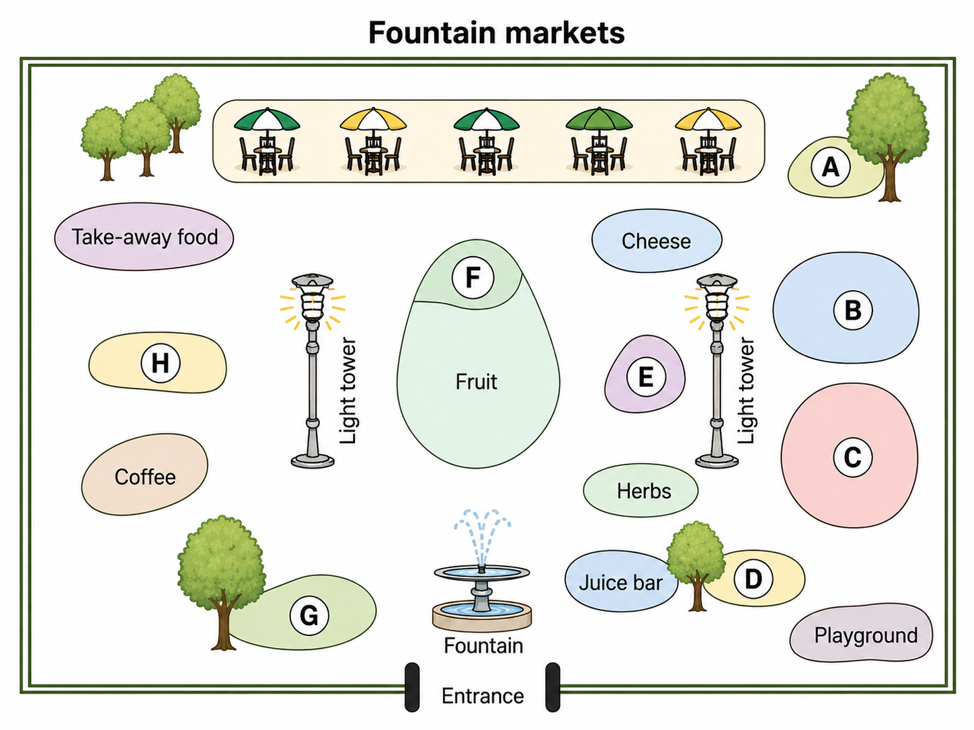
| A | B | C | D | E | F | G | H | |
|---|---|---|---|---|---|---|---|---|
| 16 Tea | ||||||||
| 17 Bread | ||||||||
| 18 Spices | ||||||||
| 19 Meat and fish | ||||||||
| 20 Nuts |
Cycling Report
Questions 21 and 22
Choose TWO letters, A–E.
Which TWO benefits of cycling for society do the students agree to include in their report?
Questions 23 and 24
Choose TWO letters, A–E.
Which TWO aspects of bicycle theft will the students find out more about?
Questions 25–30
What positive feature do the speakers identify for each of the following types of bicycle lock?
Choose SIX answers from the box and select the correct letter, A–H, next to questions 25–30.
Deformed Wing Virus
Questions 31–40
Complete the notes below.
Write ONE WORD ONLY for each answer.
Presentation on a bee disease
Background
- • Bee numbers are declining.
- • This may be due to changes in habitat and or to disease.
- • The decline has affected bee lifespans and the of locations they inhabit.
- • Bees are important as they are pollinators – they fertilize plants.
- • A significant amount of all our food, including fruit and , comes from pollinated plants.
- • An example of a pollinated non-food plant is
- • Carrying out artificial pollination by hand, using a small , is not cost-effective
Deformed Wing Virus (DWV)
- • A transfers the virus between bees.
- • DWV has a harmful effect on bees’ wings and
- • It also affects cognitive functions, especially their memory.
Research into DWV
Aim
- • To find out whether DWV is transmitted from honeybees to bumblebees (wild bees).
Research
- • 26 sites were identified and infected honeybees and bumblebees were captured.
- • The virus strain found in both species was , but less frequent in bumblebees.
- • Conclusion: the disease is probably transmitted from honeybees to bumblebees.
Suggested solutions
- • Encourage farmers to share data on infection rates.
- • Develop convenient that non-scientists can carry out.
- • Cut down on , which may affect bees’ immune systems.